The Reality of Diana and Milka in the Healthcare System
One question echoes in every corner of Mexico. Is it fair that so many families face a healthcare system that forces them to fight alone against problems that should be solved collectively?
This is the reality Diana faces every day as she cares for her daughter, Milka. Milka lives with severe multiple cerebral palsy. For Diana, it is a constant reminder of how a medical delay changed her daughter’s life.
“They took too long to help me when Milka was born, she was suffocating.” Diana doesn’t say it with anger, but with resignation.
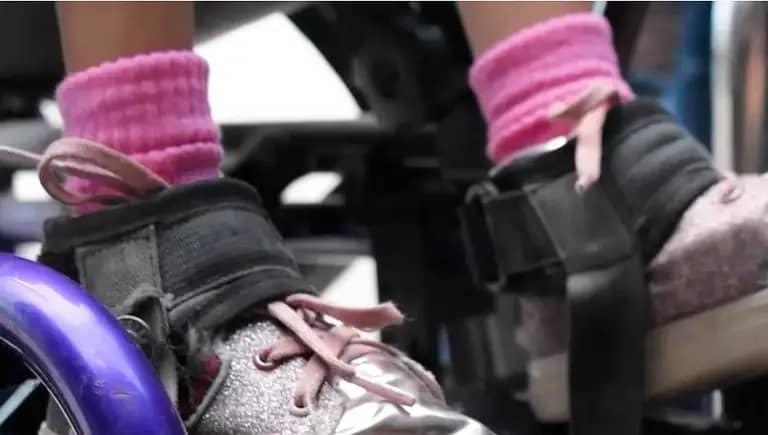
We sit in the small living room of her home in Ciudad Juárez. The space is simple, but warm. Milka is beside her, in a wheelchair, her small arms, thin but restless, keep reaching for her mother.
“It’s like she wants to give me a kiss,” Diana says, her voice breaking.
The truth is simple, in Ciudad Juárez, as in many parts of the country, access to healthcare depends on what you can afford. And for Diana, what’s in her pocket is often not enough.
“The neurologist charges me a thousand pesos, about 50 dollars, per visit,” she says, glancing at Milka with a soft smile. “Baclofen, the medication she needs, I can only get it in the U.S. right now. Without it, she becomes stiff like a board.”
Her words are not complaints, they are a statement of reality.
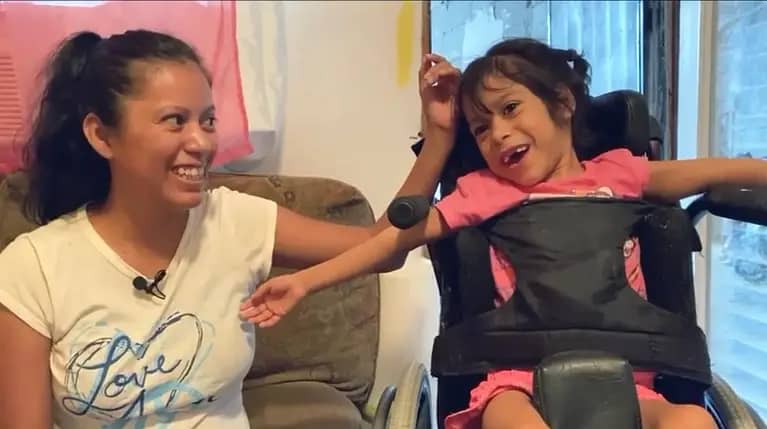
As she speaks, she holds Milka firmly. These are the same hands that sell at local markets to support her daughter, the same hands that were left without work during the pandemic.
“The pandemic has left me on the edge of hope… and despair.”
The strain shows, even when she smiles, her struggle is not unique. Many mothers along the border face the same reality, they cannot access therapy or consultations because they lack insurance, money, or both.
In Mexico, according to INEGI, 4.9 percent of the population lives with some form of disability, more than six million people. For many of them, the public healthcare system falls short.
“It’s all because of the economy,” she says quietly.
Meanwhile, Milka’s smile fills the room, as if untouched by the weight her mother carries.
“She is my driving force,” Diana says, as she kisses her hand.
Watching them, the question lingers.
Milka’s smile and Diana’s strength speak to love and resilience, but they also reveal what we, as a society, are failing to do. Every consultation Diana cannot afford, every medication she cannot obtain, every therapy Milka does not receive is a missed chance to do better.
Change may not come quickly, but stories like theirs force us to confront the kind of society we are building.
Do we accept a world where access to care depends on income? Or do we imagine something different. A system that does not turn families away, but allows them to live with dignity.
Diana’s love for Milka can carry them through almost anything.
But it should not have to.